Show support, Join us on Facebook!

Lately we created a facebook fanpag for all of us, where we can easily share our ideas and have some fun! :)

Free Ebook, Recommended for Beginner

Read Ebooks about keeping a tarantula so you will be guided accordingly =) Knowledge is power

Top 15 must know about tarantulas!

Did you know that tarantulas can grow back their leg if its lost? Read more amazing facts about tarantulas!

Show support, Join us on Facebook!

Lately we created a facebook fanpag for all of us, where we can easily share our ideas and have some fun! :)

This is default featured slide 5 title

So if you are new to the hobby better consider my top 10 list. before i made this list, what i considered is their Looks, Temperament, size and their Price.

Showing posts with label Must be edited. Show all posts

Monday, April 21, 2014

Psalmopoeus Pulcher - Panama Blond tarantula

This tarantula is best for hobbyist who are new in keeping arboreal tarantulas, Most who owns one of this spider observed that upon reaching a size of 2" above, this tarantula tend to display itself outside from its hide making it ideal for beginners (most beginners like to see their spiders)
Tarantula Information
Regions Found:Panama
Class:Arboreal
Longevity:--
Adult Size:5++inch
Temperament:Skittish, aggressive when matured
Urticating Hairs:NO
Venom Potency:--
Poecilotheria Metallica Housing Requirements
Tarantula Housing:Height is much more important than floor space, a substrate should be provided with a variety of plants and branches. Ensure branches are in a stable position and will not fall if the tarantula climbs onto it.
Temperature:22-26°C (71.6-78.8°F)
Humidity:65-75%
Special Requirements:Hides,
Poecilotheria Metallica Diet
Livefood insects such as cricketsmealwormssuperwormshouseflies and other Small insects

Thursday, January 10, 2013

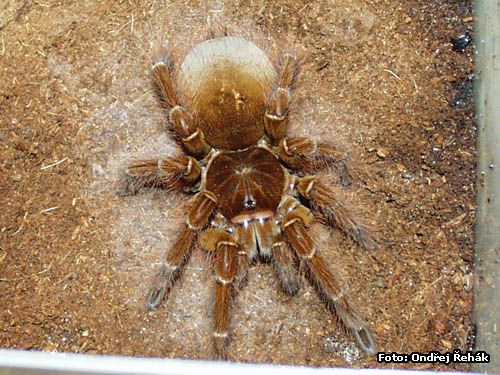
Theraphosa blondi ( Goliath Bird-eater Tarantula)

Theraphosa blondi (Goliath Bird-eater Tarantula)
This new world terrestrial tarantula is considered as the largest tarantula in the world because of its remarkable 10-12 inches leg span. It currently holds the place in the book of Guinness World Records for the largest spider and is powerful enough to feed on frogs, toads, lizards, mice and snakes.
Tarantula Information
Regions Found: Venezuela, Northern Brazil, Guyana, French Guiana and Suriname.
Class: Terrestrial
Longevity: Reach maturity in 3-5 years and females can live to 25 years (Female)
Adult Size: 10-12inches
Temperament: Very Aggressive
Urticating Hairs: Yes
Venom Potency: Strong and painful
Brachypelma smithi Housing Requirements
Tarantula Housing: Floor space is more important than height, a deep substrate should be provided for burrowing. A good retreat is required, maybe a few in strategic places.
Temperature: 24-28°C (75-86°F)
Humidity: 80%
Special Requirements: Humidity needs to be increased near a moult to prevent problems
Brachypelma smithi Diet
Livefood insects such as cricketsmealwormssuperwormshouseflies and other Small insects

Holothele inceis (Holothele incei tarantula)

to be edited

Wednesday, January 9, 2013

Acanthoscurria borealis

Acanthoscurria borealis was first identified by Schmidt & Peters last 2005, it is found in Central America. its Spermathecae is similar to Acanthoscurria Musculosa
Tarantula Information
Regions Found: Central America
Class: Unknown.
Longevity: Unknown..
Adult Size: Unknown.
Temperament: Unknown.
Urticating Hairs: Unknown.
Venom Potency: Unknown
Acanthoscurria borealis Housing Requirements
Tarantula Housing: Unknown..
Temperature: Unknown.
Humidity: Unknown.
Special Requirements: No special requirements.
Acanthoscurria borealisDiet
Livefood insects such as cricketsmealwormssuperwormshouseflies and other Small insects

Acanthoscurria aurita

Acanthoscurria aurita was first identified by Piza in 1939,
This specie of tarantula as of now has no recorded information in captivity.
Tarantula Information
Regions Found: Brazil
Class: Unknown.
Longevity: Unknown..
Adult Size: Unknown.
Temperament: Unknown.
Urticating Hairs: Unknown.
Venom Potency: Unknown
Acanthoscurria aurita Housing Requirements
Tarantula Housing: Unknown..
Temperature: Unknown.
Humidity: Unknown.
Special Requirements: No special requirements.
Acanthoscurria aurita Diet
Livefood insects such as cricketsmealwormssuperwormshouseflies and other Small insects

Acanthoscurria antillensis (Antilles Pink Patch Tarantula)


Acanthoscurria antillensis was first identified by Pocock, 1903 This specie is native to Lesser Antilles (also known as the Caribbees) this are deep burrowing so better keep your substrate deep, This species is overall brown in color, lighter brown with a copper colored sheen to it. This species needs constant supply of water, other keeping requirements are the same as Acanthoscurria Geniculata
Tarantula Information
Regions Found: Brazil
Class: Terrestrial
Longevity: Very Slow after 6 years, it can reach only for 4inches
Adult Size: 4-5inch
Temperament: Unknown
Urticating Hairs: Probably yes.
Venom Potency: Unknown
  Acanthoscurria antillensis Housing Requirements
Tarantula Housing: Deep substrate should be provided for burrowing. Around 6inches deep will do.
Temperature: 24-28°C (75-86°F)
Humidity: 75%
Special Requirements: Regular Misting,
  Acanthoscurria antillensis Diet
Livefood insects such as cricketsmealwormssuperwormshouseflies and other Small insects

Photo Ray Gabriel © 2004